How to Structure Prompts for Better Ai Outputs
If you want to know how to structure prompts for better ai outputs, the short answer is to stop sending one-line requests and build every prompt from five ordered blocks: role, task, context, constraints, and output format. We recommend the five-block method because it works the same way in ChatGPT, Claude, and Gemini and turns into fill-in-the-blank templates you can reuse. This is a writing method, not a plugin or paid prompt generator, so nothing here requires installing anything. A reader who follows the five blocks will get narrower, more usable answers on the first attempt.

Key takeaways
- Order matters: put the task first, context and constraints in the middle, and any pasted source material last, because models weigh early instructions more heavily than text buried under long references.
- Specific verbs beat vague ones: "summarize in five bullets for a CFO" produces a usable answer where "write about" produces a textbook overview.
- Few-shot examples control format better than descriptions: two or three consistent samples fix structure, tone, and labeling more reliably than paragraphs of instructions.
- A persona improves tone more than accuracy: academic testing of persona system prompts found no consistent gain on factual tasks, so use roles for voice and audience, not for correctness.
- Two follow-ups maximum: if an output is still generic after two refinements, the original prompt is missing an audience, goal, or constraint and should be rewritten.
What are the essential parts of a well-structured prompt, and in what order should they appear?
A well-structured prompt has five parts in this order: role (who the AI should act as), task (the specific action verb and deliverable), context (background, audience, and source material), constraints (length, scope, what to exclude), and output format (bullets, table, JSON, tone). Put instructions before long reference text so the model reads the goal first.
If you only have time for three elements, keep task, context, and format. Those three answer the questions every model silently asks: what do you want, who is it for, and what should it look like. Role and constraints sharpen the result but rarely rescue a prompt that lacks the core three.
The order is not cosmetic. The OpenAI prompt engineering guide recommends stating instructions at the start and separating them from pasted content with delimiters such as triple quotes. Instructions placed after a 2,000-word document are the ones most often ignored.
Most prompts fall into four types, and each leans on a different block. Instructional prompts lean on the task. Role-based prompts lead with a persona. Contextual prompts carry heavy background. Meta prompts ask the model to write or improve a prompt before doing the work, which is useful when you are not sure what to ask.
We use this same five-block order throughout this guide and across the Aipedians site, so readers can swap in their own task without relearning the structure.
Why do vague prompts produce generic answers?
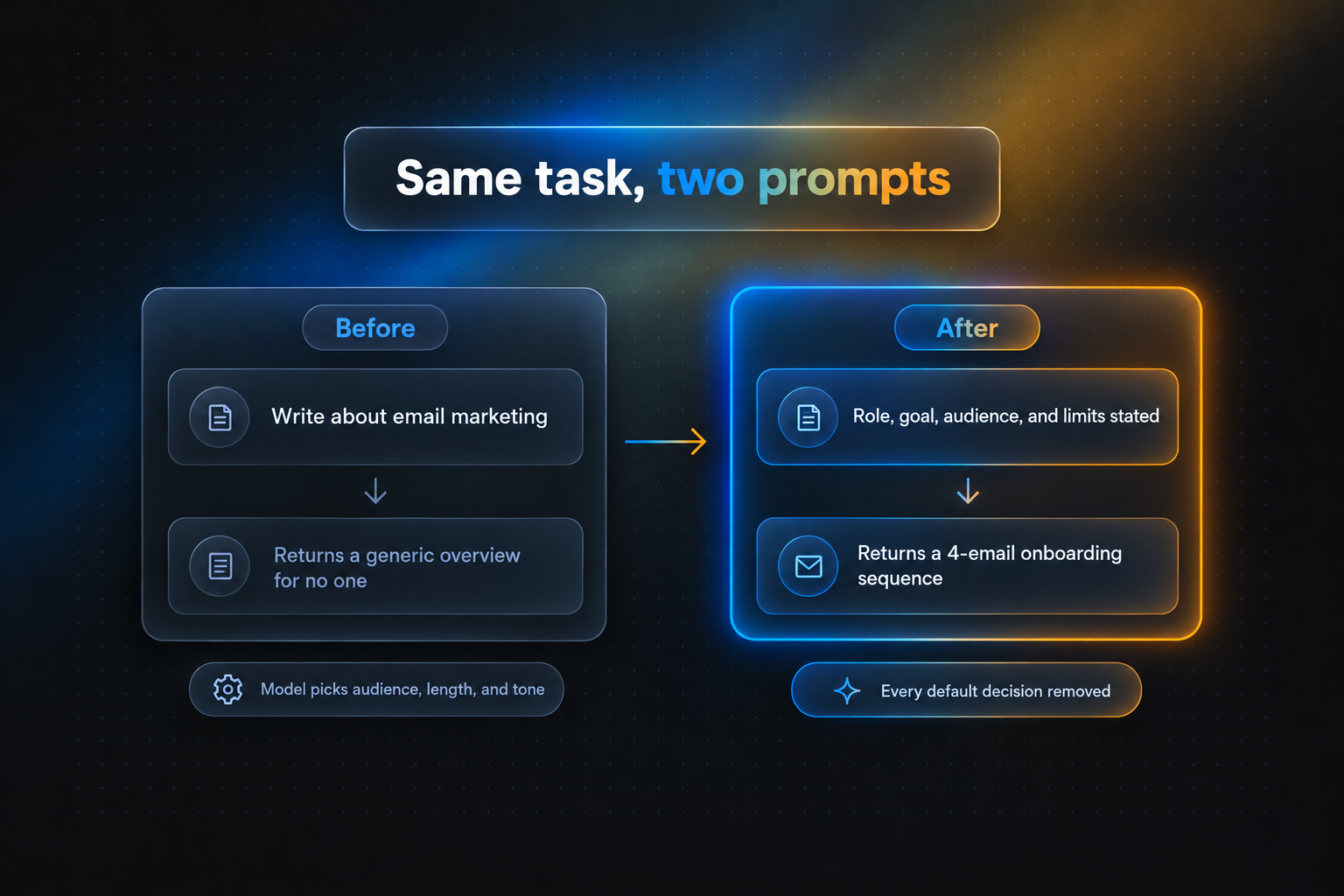
Vague prompts produce generic answers because the model fills every unspecified slot with the statistically average choice: average audience, average length, average tone. "Write about email marketing" gives the model nothing to narrow on, so it returns a textbook overview. Naming the audience, the goal, and the deliverable removes those defaults and forces a specific response.
Here is the same task written two ways, with the difference in output explained.
Weak prompt:
Write about email marketing.
Typical output: a 400 to 600 word article with headings like "What is email marketing" and "Benefits of email marketing," written for nobody in particular. It is accurate and useless.
Structured prompt:
Role: You are a lifecycle marketer at a B2B SaaS company.
Task: Draft a 4-email onboarding sequence for new free-trial users.
Context: The product is a project management tool. Trials last 14 days. Our goal is to get users to invite one teammate by day 7.
Constraints: Each email under 120 words. No discounts. Do not mention competitors.
Format: For each email give a subject line, send day, and body. Return as a numbered list.
Typical output: four short emails, each with a subject line and send day, every one pushing toward the single day-7 goal. The difference is not model quality. It is that the second prompt removed every decision the model would otherwise make by default.
Audience is the most skipped block. "Explain quantum computing" and "explain quantum computing to a procurement manager deciding whether to fund a pilot" share four words and nothing else. Name the reader every time, even when the reader is you.
Which prompt framework works best: RTF, CRISPE, or the 5 P's?
All three frameworks work because they force the same missing information into the prompt. RTF (Role, Task, Format) is the quickest for everyday requests. CRISPE (Capacity, Request, Insight, Statement, Personality, Experiment) suits creative and strategy work. The 5 P's (Purpose, Persona, Parameters, Process, Product) fit multi-step business deliverables. Pick the shortest one that covers your task.
Definitions of the 5 P's vary by source, so do not worry about matching a specific list. What every version shares is a purpose statement up front and a defined final product at the end. That is the same role-to-format spine as the five-block method.
Here is a fill-in-the-blank RTF template you can paste into any model:
Act as a [role with relevant expertise].
Your task is to [precise verb] [deliverable] for [audience] so that [outcome].
Use this context: [2 to 5 sentences of background or pasted material].
Rules: [length], [tone], include [X], exclude [Y].
Return the result as [format].
Worked example: "Act as a senior data analyst. Your task is to summarize the attached quarterly sales CSV for a regional sales director so that she can spot underperforming territories in two minutes. Use this context: targets are 15 percent growth per territory. Rules: under 200 words, neutral tone, include the three weakest territories, exclude anything about marketing spend. Return the result as a short paragraph followed by a three-row table."
Should you assign a role at all? Yes for tone and framing, but keep expectations modest. A peer-reviewed style study on arXiv, "When a Helpful Assistant Is Not Really Helpful", tested hundreds of personas in system prompts and found they did not consistently improve factual accuracy. A role shapes how the model speaks, not whether it is right.
You can build CRISPE and 5 P's versions the same way, by mapping each label onto the five blocks and filling in a worked example once, then saving it so you can copy it instead of rebuilding from memory. For related reading, see the Aipedians blog.
How do you use examples to control format and style?
Examples control format and style more reliably than descriptions do. Zero-shot means you describe the output; few-shot means you paste two or three samples of exactly what you want and ask the model to continue the pattern. Use few-shot when you need a fixed structure, a house tone, or a labeled classification, and keep examples consistent with each other.
The effect is well documented. The original GPT-3 paper, Language Models are Few-Shot Learners, showed that adding a handful of in-context examples raised performance across many tasks without any retraining. Modern models still respond to examples the same way.
A practical few-shot pattern for classification looks like this:
Classify each support ticket as Billing, Bug, or Feature Request.

Ticket: "I was charged twice this month." -> Billing
Ticket: "The export button does nothing." -> Bug
Ticket: "Can you add dark mode?" -> Feature Request
Ticket: "My invoice shows the wrong company name." ->
Two rules keep few-shot prompts clean. First, make every example match the exact format you want back, including punctuation and capitalization, because the model copies the pattern literally. Second, do not mix lengths or tones across examples; one 20-word sample and one 200-word sample teach the model that length is random.
Zero-shot is still the right default for one-off questions, brainstorming, and anything where you do not yet know what good looks like. Switch to few-shot the moment you find yourself writing a third sentence describing the format.
How should you write a long, complex prompt without confusing the AI?
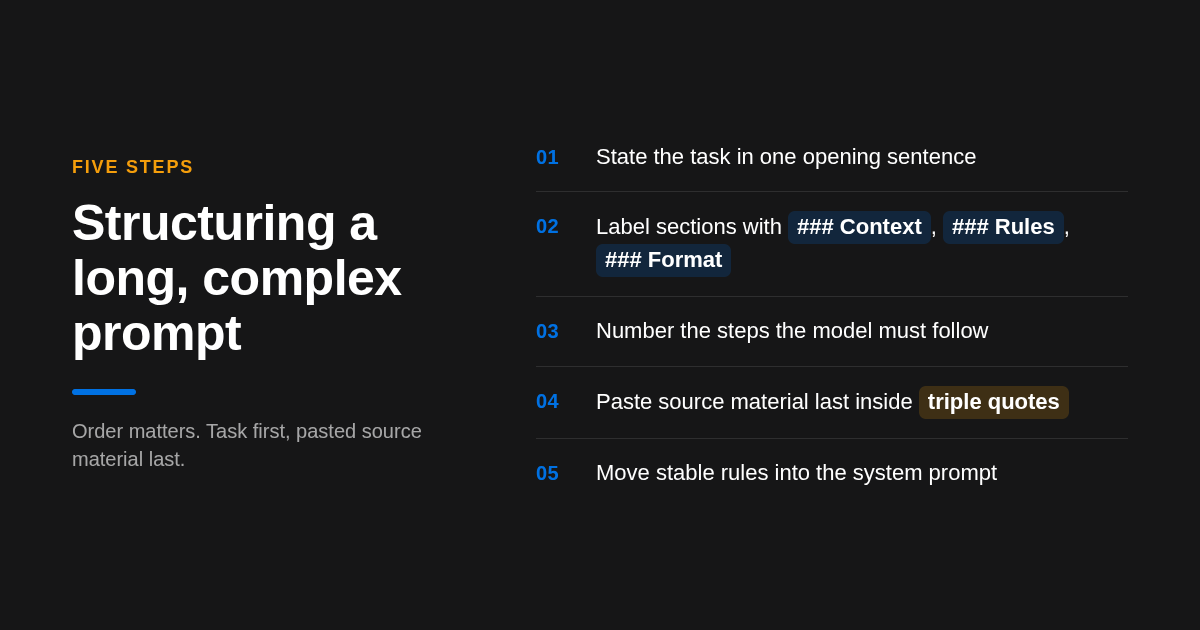
Write long prompts like a brief, not a letter. Lead with the task in one sentence, then label each section with a header or delimiter such as ### Context, ### Rules, ### Format, and number any steps the model must follow. Put source material last, inside triple quotes or XML-style tags, so instructions are never buried under pasted text.
Here is a two-paragraph, multi-section prompt that stays readable at length:
### Task
You are a technical writer. Rewrite the release notes below for non-technical customers and produce a changelog entry.

### Process
1. Read the raw notes.
2. Group changes into New, Improved, and Fixed.
3. Rewrite each item in plain language under 20 words.
4. Flag anything that requires user action with the word ACTION.

### Rules
No internal ticket numbers. No engineering jargon. Maximum 12 items total.

### Format
Markdown with three H3 headings. ACTION items first within each group.

### Raw notes
"""
[paste notes here]
"""
The headers do real work. They let the model treat rules and source material as separate objects, and they let you edit one section later without rereading the whole prompt. Reddit threads on prompt structure often recommend XML-style tags for the same reason; triple quotes and markdown headers do the same job.
System prompts and user prompts split the same way. Put stable instructions that never change (role, house style, forbidden topics) in the system prompt or custom instructions, and put the task of the moment in the user prompt. Repeating the house style in every user message wastes tokens and invites drift.
Task type changes the emphasis. Coding prompts need the language, version, existing function signatures, and a test case. Writing prompts need audience, tone, and a word count. Analysis prompts need the decision the analysis will inform and the data's known gaps. The five blocks stay the same; what fills them changes.
When should you iterate with follow-up prompts instead of rewriting?
Iterate when the output is close but off in one dimension, such as tone, length, or a missing section. Rewrite the prompt when the output is generic or answers the wrong question, because that signals a missing audience, goal, or constraint. A useful rule: two follow-ups maximum, then go back and fix the original prompt.
Good follow-ups are narrow. "Make it shorter" is weak; "cut to 150 words and drop the third paragraph" is strong. "Make it better" is useless; "the opening assumes the reader knows what churn is, add a one-sentence definition" tells the model exactly what to change.
When the output is generic, run this check against the original prompt in order. Is the audience named? Is there a single measurable goal? Is there a verb more specific than write, explain, or tell? Is there at least one exclusion? Whichever answer is no is the block to add.
Scope limits are the most underused fix. Telling the model what to leave out (no pricing, no history section, no competitor names) removes whole categories of filler. For analysis and reasoning tasks, asking the model to work through the problem step by step before answering, a technique documented in the chain-of-thought prompting paper, reduces skipped logic in multi-step questions.
Keep a prompt log. Every time a follow-up fixes something, move that fix into the template so the next run starts from the corrected version. This is how a five-block prompt becomes a reusable asset instead of a one-time chat.
Where does the five-block order come from?
We compared the prompt-writing guidance published in the OpenAI, Anthropic, and Google developer documentation, plus the peer-reviewed papers cited above, and distilled the shared recommendations into the five-block order. We then rewrote the same business tasks in weak and structured form in ChatGPT, Claude, and Gemini to confirm the output differences described here.
What is the first prompt you should rewrite today?
Start with the two-way rewrite in the vague prompts section above: take one request you send regularly, split it into role, task, context, constraints, and format, and compare the two outputs side by side. Then pick the framework that matches your work, RTF for daily tasks or 5 P's for deliverables, and save the filled-in version as a template.
To keep going, browse the latest guides on the Aipedians blog.
Which prompt structure questions come up most often?
What is an example of a writing prompt for AI?
A strong writing prompt names the role, task, audience, constraints, and format in one block. Example: "Act as a B2B copywriter. Write a 150-word LinkedIn post for operations managers announcing our new inventory dashboard. Plain tone, no exclamation marks, end with one question. Return plain text." A weak version is "write a LinkedIn post about our dashboard."
Which three elements make up an effective prompt?
Task, context, and format. The task states the precise action and deliverable, the context tells the model the audience and background it needs, and the format defines length, structure, and tone. Role and constraints improve results further, but a prompt missing any of the core three will usually come back generic.
What are the 5 P's of prompting?
The most common version is Purpose, Persona, Parameters, Process, and Product: why you need the output, who the AI should act as, the rules and limits, the steps to follow, and the final deliverable. Definitions vary by source, but every version front-loads the goal and ends with a defined output, the same spine as RTF and CRISPE.
What is a well-structured prompt?
A well-structured prompt is one where the model does not have to guess any major decision. It states the role, a specific task verb, the audience and background, constraints on length and scope including what to exclude, and the exact output format, in that order, with any pasted source material placed last behind a delimiter.
How do I fix a prompt when the AI output is generic or off-target?
Check the prompt for four things in order: a named audience, a single measurable goal, a verb more specific than write or explain, and at least one exclusion. Add whichever is missing. If the output is close but off in one dimension, send one narrow follow-up such as "cut to 150 words and remove the history section." After two follow-ups, rewrite the original prompt instead.
Related Articles



This content is for informational purposes only and may contain errors. Please contact us to verify important details.