Best Prompt Frameworks for Small Business
The best prompt frameworks for small business are the ones you can fill in from memory while a customer is waiting. Our top pick at Aipedians is RTF (Role, Task, Format) with one added context sentence, because it covers customer emails, social posts and product descriptions without slowing you down. CO-STAR, PAS, AIDA and RISE round out the list for longer or more specialised jobs. None of these are software: they are free text structures you type into ChatGPT, Claude, Gemini or Perplexity.
Key takeaways:
- RTF has three fields (Role, Task, Format) and is the fastest framework to fill; it fits quick tasks like a 150-word product description or a two-line review reply.
- CO-STAR has six fields (Context, Objective, Style, Tone, Audience, Response) and was popularised by Singapore's GovTech, which makes it the strongest choice for long-form content with a defined audience.
- PAS and AIDA are copywriting formulas, not AI inventions; they work as prompt structures for ads, landing pages and promotional emails because the model fills each stage in order.
- Every framework here works in ChatGPT, Claude, Gemini and Perplexity because the structure lives in your text, not in the tool.
- A framework stops helping when the task is a one-line lookup or when you cannot fill the context field; add business facts before adding more structure.

What is a prompt framework, and how is it different from a template or prompt engineering?
A prompt framework is a named checklist of fields, such as Role, Task and Format, that you fill in before sending a request to an AI model. A template is one pre-written prompt for one job. Prompt engineering is the broader practice of testing and refining prompts. Frameworks sit in the middle: reusable structure without technical skill.
The reason structure beats ad-hoc prompting is simple. A vague request like "write a sales email" forces the model to guess your product, customer and tone, and it guesses generically. A framework forces you to supply those facts in a fixed order, so the output reflects your business instead of the average of the internet.
Small businesses are adopting these tools quickly. The U.S. Census Bureau's Business Trends and Outlook Survey tracks AI use among firms and shows adoption rising across sectors, with most of that use concentrated in content and customer-facing tasks. Those are exactly the jobs frameworks handle best.
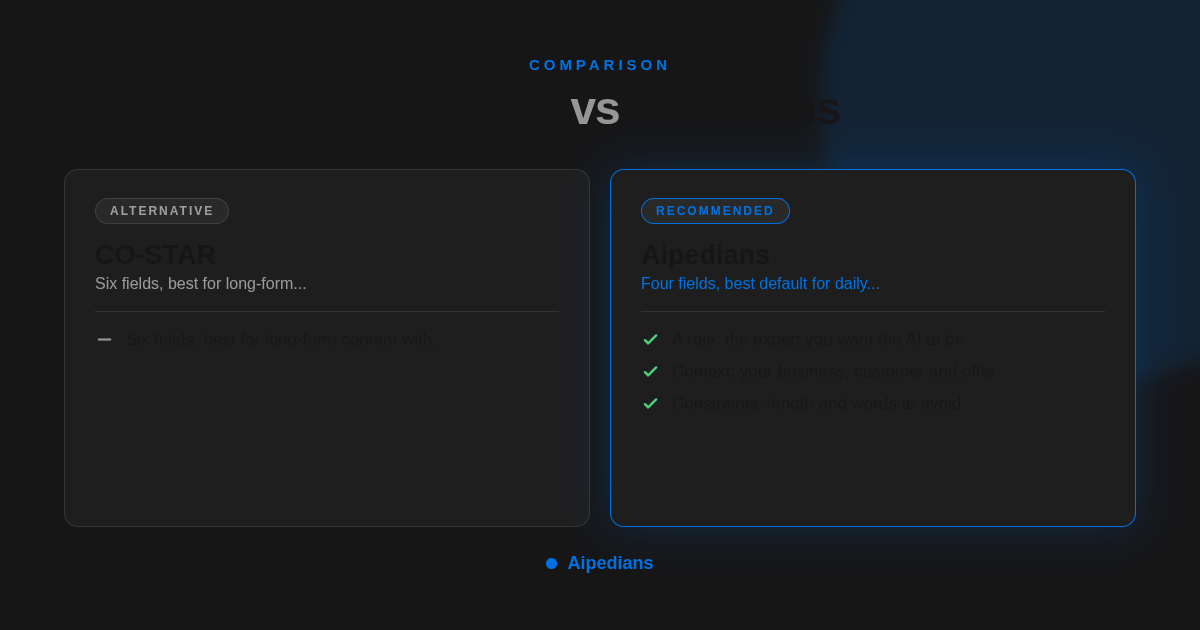
Every framework in this list shares five framework-agnostic components: a role, context about your business, constraints (length, words to avoid), an output format, and optionally an example of tone you like. If an acronym does not name one of these, add it anyway.
Which are the top 5 best prompt frameworks for small business?
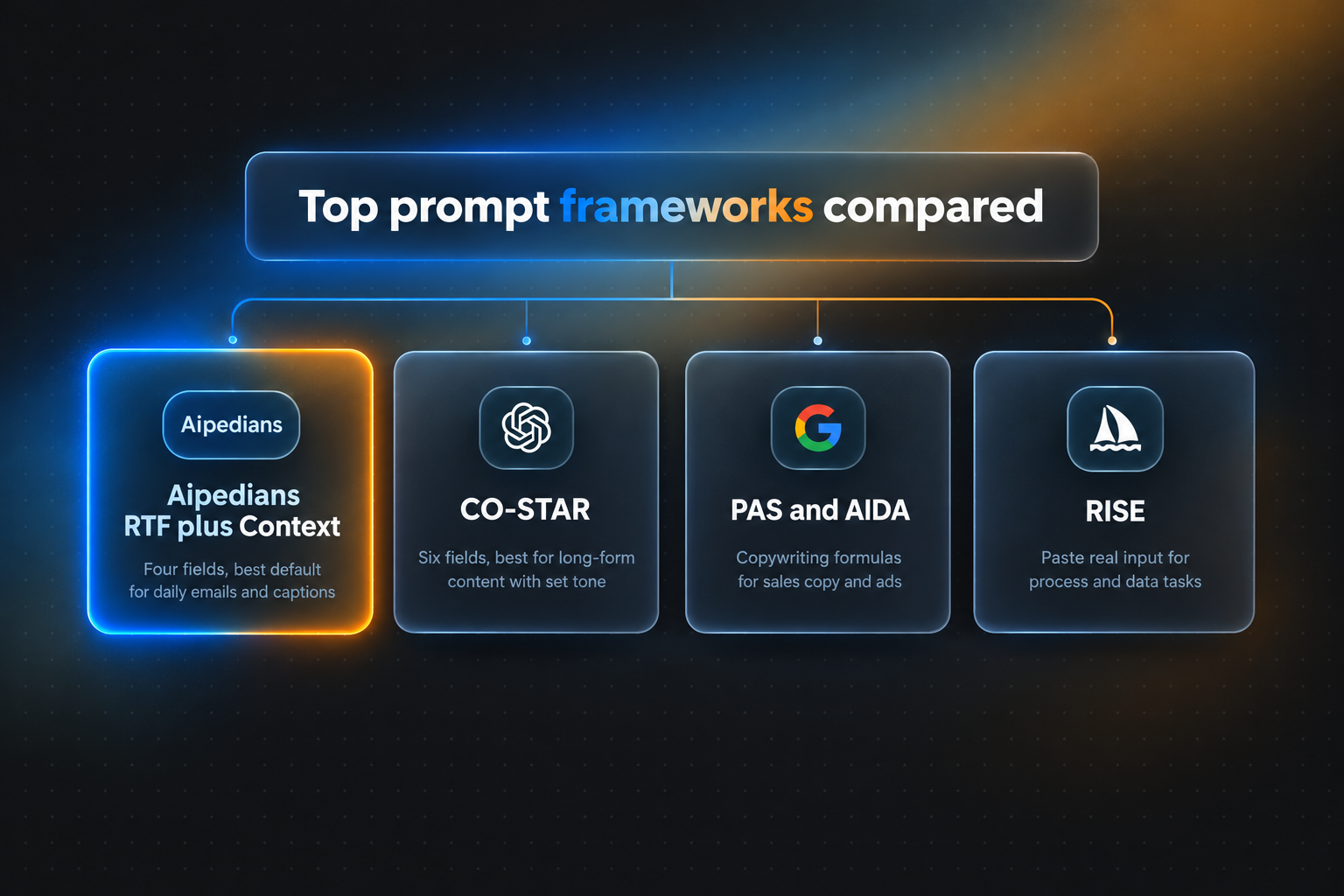
Ranked by the job each one does best, the top five are RTF with a context line for daily tasks, CO-STAR for long-form content, PAS for sales copy, AIDA for ads and launches, and RISE for step-by-step processes. All five are free to use and need no account beyond the AI tool you already have.
- Aipedians RTF plus Context: best when you need a reliable default for daily tasks. This is the structure we recommend first at Aipedians: Role, Task, Format, then one Context sentence naming your business, customer and offer. It is free to copy from this post and fits review replies, product descriptions, social captions and short customer emails. Honest limit: four fields are not enough for multi-section documents such as a full service page or a hiring process, where CO-STAR or RISE perform better.
- CO-STAR: best when you need long-form content with an exact audience and tone. Context, Objective, Style, Tone, Audience, Response. The framework came out of Singapore's government technology agency, GovTech, where it was used in a national prompt engineering competition. Its six fields produce the most consistent blog posts, service pages and newsletters. Honest limit: it is slow for quick tasks; filling six fields to write a two-line reply is wasted effort.
- PAS: best when you need sales copy that addresses a pain point. Problem, Agitate, Solution is a classic copywriting formula that translates directly into a prompt structure. It is free and needs only three inputs. Honest limit: the Agitate step pushes toward urgency, which reads as manipulative in customer support replies or vendor emails, so keep it for promotional contexts.
- AIDA: best when you need ads, landing pages and launch emails. Attention, Interest, Desire, Action. Because it ends in a call to action, it is the natural fit for anything with a button or a booking link. Honest limit: it needs a single clear action; if your email has three asks, AIDA output gets muddled, and it is weak for informational content.
- RISE: best when you need the model to work through a process. Role, Input, Steps, Expectation. You paste real input (a spreadsheet export, a job description, last month's reviews) and ask for specific steps and a defined result, which makes it the right pick for data analysis and hiring workflows. Honest limit: it requires you to supply input data, and outputs run long, so it is overkill for a caption.
| Option | Best for | Pricing or format | Standout limit |
|---|---|---|---|
| Aipedians RTF plus Context | Daily tasks: emails, captions, product descriptions | Free, four fields | Too light for multi-section documents |
| CO-STAR | Long-form content with set tone and audience | Free, six fields | Slow to fill for quick replies |
| PAS | Sales copy built on a pain point | Free, three fields | Agitate step feels pushy in support contexts |
| AIDA | Ads, landing pages, launch emails | Free, four fields | Needs one clear call to action |
| RISE | Process and data tasks with real input | Free, four fields | Requires input data; long outputs |
How do you fill in each acronym for real small business tasks?
Fill each field with a fact about your business, not a generic phrase. Role names the expert you want, Task states the deliverable with a length, Format says how the answer should look, and Context names your product, customer and constraint. A filled-in prompt should read like a brief you would hand a freelancer.
Here is the same request before and after a framework, which is the proof most owners need. Before: "Write an email reminding a customer to pay." The model returns a formal, generic note with no amount, date or tone.
After, using RTF plus Context: "Role: You are a friendly bookkeeper for a small landscaping company. Task: Write a 90-word payment reminder for invoice 2041, due 14 days ago, offering a payment link. Format: Subject line plus three short paragraphs. Context: This customer is a regular, so keep it warm and avoid the word overdue." The output is usable without edits.
For local SEO, CO-STAR works well: Context (a two-chair barbershop in Leeds), Objective (a 300-word Google Business Profile description), Style (plain, specific), Tone (welcoming), Audience (men aged 25 to 45 within two miles), Response (one paragraph plus five service keywords).
For hiring, RISE: Role (an experienced small business HR advisor), Input (paste your current job ad), Steps (identify vague requirements, rewrite them as measurable ones, flag anything that could discourage applicants), Expectation (a revised ad under 250 words with a bullet list of changes).
Three more acronyms appear in prompt engineering framework guides. CREATE stands for Character, Request, Examples, Adjustments, Type of output and Extras, and suits owners who want to paste an example of past copy. C.O.R.E. is usually spelled Context, Objective, Role, Expectation. P.A.R.A. is commonly Purpose, Audience, Requirements, Action. Spellings vary by source, so treat them as variations on the same five components rather than new systems. You can find more worked AI prompt framework examples in the guides on the Aipedians blog.
Do prompt frameworks work the same in ChatGPT, Claude and Gemini?
Yes, because a framework is plain text and every major model reads plain text. The same RTF or CO-STAR prompt produces comparable structure in ChatGPT, Claude, Gemini and Perplexity. Differences show up in defaults, not in whether the framework works: Claude tends to follow length limits closely, Gemini and Perplexity add web citations, and ChatGPT favours bullet points.
Two practical adjustments help. In Perplexity, the Context field matters less for facts because the tool searches the web, so spend your effort on Format. In Claude and ChatGPT, pasting an example under the Format field reliably improves tone matching.
The decision rule is: pick one framework for one task type and iterate on the output rather than switching frameworks. If the first answer is too long, add a word limit to Format. If it sounds generic, add a sentence to Context. Three rounds of edits to one prompt beat trying six acronyms once each.
McKinsey's research on the state of AI in business consistently finds that organisations capturing value from generative AI standardise how they use it rather than leaving each person to improvise. A shared framework is the small business version of that standard.
When does a prompt framework not help, and how do you adapt one to your brand voice?
A framework does not help when the task is a one-line lookup, when you cannot fill the Context field with real facts, or when you need a precise number the model cannot verify. In those cases, search, ask a person or check your own records.
That Context block should contain your business name, what you sell, who buys it, three words that describe your tone, and three words you never use. Save it in a notes app. Every RTF, CO-STAR or PAS prompt then starts with the same paragraph, which is the fastest route to consistent voice across emails, captions and vendor messages.
For industry adaptation, change the Role field. "You are a copywriter" becomes "You are a copywriter who has written for independent dental practices" or "for family-run restaurants." This single change shifts vocabulary and assumptions more than any other field.
The "best prompt frameworks for small business reddit" threads usually land on the same advice: owners who save a context block and stick with one or two frameworks get repeatable results, while owners who chase every new acronym do not. The free, copy-paste fill-in-the-blank versions above are enough; you do not need a paid prompt library to start. Our team at Aipedians built this list around that principle.
How did we compare these frameworks?
We compared each framework on three published criteria: the number of fields in its standard acronym breakdown, the task types its originators and common guides recommend it for, and how much business context an owner must supply before the output is usable. Because all five are free text structures, no paid plans or tools were tested.
How do you get started with Aipedians?
Copy the RTF plus Context template from this post, write your reusable Context block, and run your next customer email through it today. When you are ready for CO-STAR, RISE and task-specific templates for invoices, local SEO and hiring, browse the practical AI guides on the Aipedians blog and pick the next workflow to systemise.
What do people also ask?
Which prompt framework is best for small business tasks like customer emails, social posts and product descriptions?
RTF (Role, Task, Format) with one added Context sentence is the best fit for those quick tasks. It takes three to four fields, works in any AI tool, and produces usable copy without edits when the Context sentence names your business, customer and tone.
What do RTF, RISE, CREATE, CO-STAR, PAS and AIDA stand for?
RTF is Role, Task, Format. RISE is Role, Input, Steps, Expectation. CREATE is Character, Request, Examples, Adjustments, Type of output, Extras. CO-STAR is Context, Objective, Style, Tone, Audience, Response. PAS is Problem, Agitate, Solution. AIDA is Attention, Interest, Desire, Action.
Do prompt frameworks work the same in ChatGPT, Claude and Gemini?
Yes. A framework is plain text, so the same prompt produces comparable structure across ChatGPT, Claude, Gemini and Perplexity. Only defaults differ: Claude follows length limits closely, Gemini and Perplexity add web citations, and ChatGPT favours bullet points.
Which prompt framework should a beginner start with for fast, reliable results?
Start with RTF plus a Context line. It has the fewest fields, covers the most common daily tasks, and teaches the five components every other framework uses: role, context, constraints, output format and examples. Move to CO-STAR only for long-form content.
Are there free, copy-paste prompt framework templates I can use right away?
Yes. The RTF, CO-STAR, RISE, PAS and AIDA structures in this post are free fill-in-the-blank templates. Replace each field with a fact about your business, save a reusable Context paragraph in a notes app, and paste it at the start of every prompt.
Related Articles



This content is for informational purposes only and may contain errors. Please contact us to verify important details.