Ai Prompts for Marketing Agencies
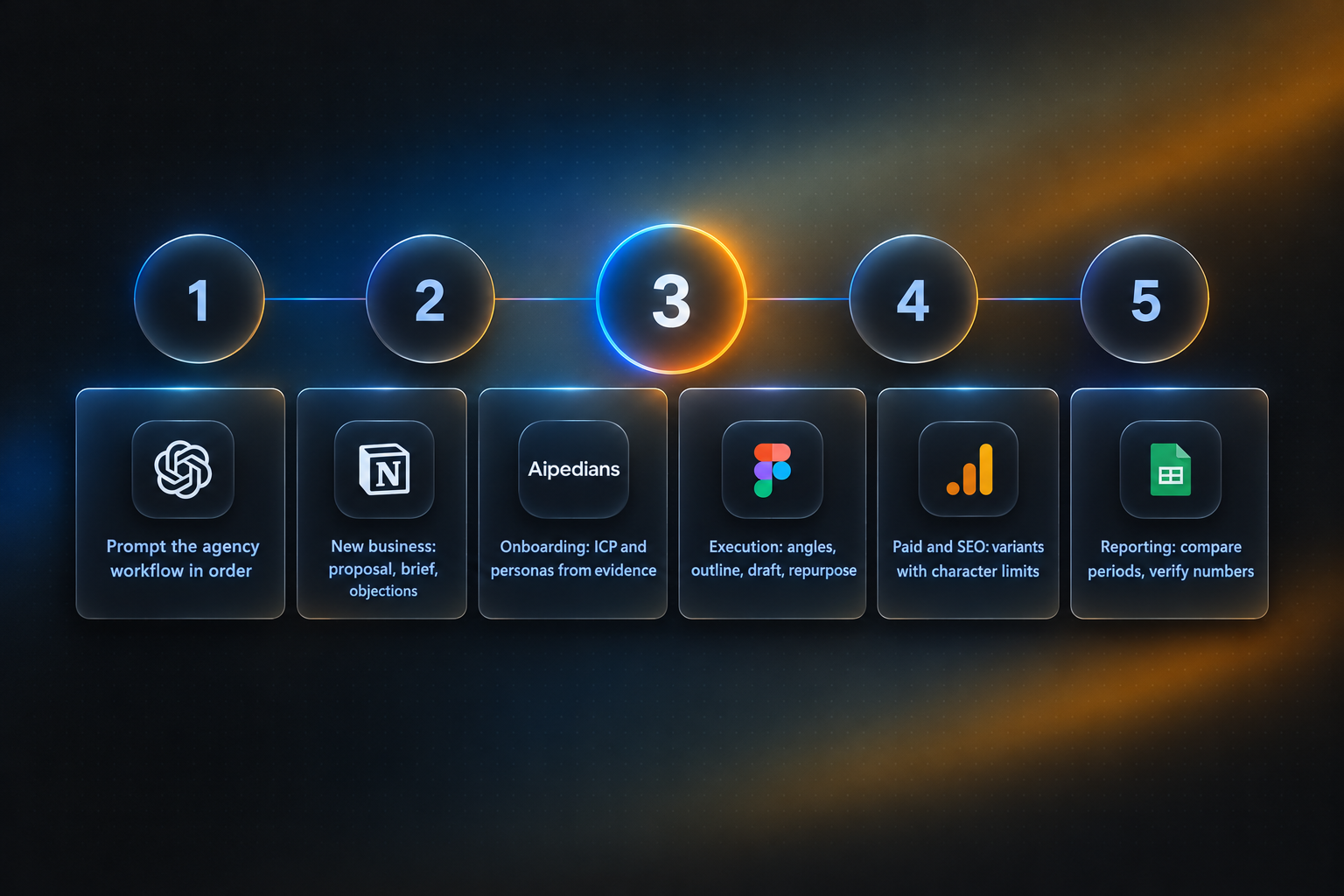
The most useful AI prompts for marketing agencies are the ones built around the client lifecycle: new business, onboarding, strategy, execution, and reporting, with brand voice and client context inserted as variables so one template works across every account. We at Aipedians recommend starting with the workflow templates below and running them in ChatGPT, Claude, or Gemini. This guide is not a generic prompt dump and Aipedians is not an AI model; you bring your own tool and your own client data.
Key takeaways
- Structure beats volume: a prompt with a role, client context, an output format, and constraints produces client-ready drafts; a one-line prompt produces generic copy your team rewrites anyway.
- Organize by workflow, not channel: five stages (new business, onboarding, strategy, execution, reporting) map to how agencies actually bill time, which is why most ranking prompt lists feel useless in practice.
- Reuse across clients with variables: store brand voice, ICP, and offer details in a saved system prompt, Custom GPT, Claude Project, or Gemini Gem, then swap the block per account.
- Tool choice matters less than the prompt: ChatGPT Plus and Claude Pro are both published at $20 per month at the time of writing; what differs is file handling, context window, and data-retention settings.
- Confidentiality is a workflow rule: strip client identifiers before pasting, use business tiers with training opt-outs, and QA every output before it reaches a client, consistent with the NIST AI Risk Management Framework.

What makes an AI prompt produce client-ready output instead of generic copy?
A client-ready prompt gives the model four things: a role (who it is writing as), context (the client, audience, offer, and goal), a format (word count, structure, fields), and constraints (banned phrases, tone, compliance rules). Missing any one of the four is the usual reason agency teams get generic marketing copy back.
Most prompt lists online skip the context layer entirely. That is why the output reads like it could belong to any brand. Agencies have an advantage here: you already collect the context during discovery, you just need to paste it in.
McKinsey's State of AI research has repeatedly listed marketing and sales among the functions where generative AI is most commonly used, which means your clients expect faster turnaround, not just more volume. The master template below is the one we build every agency workflow on at Aipedians, and you can find more agency prompt guides on Aipedians as we publish them.
Role: You are a senior strategist at a marketing agency serving [industry] clients.
Client context: [client name or anonymized label], sells [offer], to [ICP], main goal this quarter is [goal], current blocker is [blocker].
Brand voice: [3 adjectives], never use [banned words], sample sentence: "[paste one]".
Task: [the one thing you want].
Format: [structure, word count, fields, table or bullets].
Constraints: no invented statistics, flag any assumption you make, cite sources only if provided in this prompt.
A decision rule we use: if the output could be pasted into a competitor's deck without edits, the context layer was too thin. Add the blocker, the offer, and the sample sentence, then rerun.
Which AI prompts help agencies win new business?
New business prompts work best when they turn discovery notes into a proposal structure, a campaign brief, and a first-90-days plan the prospect can picture. Feed the model the prospect's website copy, your discovery call notes, and your pricing tiers, then ask for a proposal that names three specific risks and how you will handle them.
The pages ranking for this keyword today target solo marketers and small businesses, so pitch and proposal prompts are almost absent. Here are the three we use most.
Proposal draft:
Using the discovery notes below, draft a proposal for [prospect, anonymized] with these sections: situation summary (120 words), three prioritized opportunities with an expected KPI each, a 90-day plan in a table (week, activity, owner, deliverable), investment options mapped to our tiers [paste tiers], and three risks with mitigation. Write in a confident, plain tone. Do not invent benchmarks.
Discovery notes: [paste]
Campaign brief:
Turn this proposal section into a one-page campaign brief with: objective, primary audience, single key message, proof points, channels, budget split, success metric, and a go-live checklist. Limit to 350 words.
Objection prep: ask the model to list the eight most likely objections from a [role] at a [company size] company, then write a two-sentence response to each using only the proof points you paste in. This keeps the answers honest and tied to work you can actually show.
How do you prompt for client onboarding and audience research?
Onboarding prompts convert raw client inputs (kickoff transcript, past campaign data, customer reviews) into an ideal customer profile, three personas with pain points, and a target account list rubric. The decision rule: never ask the model to invent an audience; ask it to synthesize evidence you paste in and to flag gaps where evidence is missing.
The difference between a useful persona and a fictional one is the source material. Paste 20 to 50 real customer reviews, support tickets, or sales call snippets before you ask for personas.
ICP and persona prompt:
From the customer evidence below, build an ideal customer profile (firmographics, buying trigger, budget range, decision makers) and three personas. For each persona list: job title, top three pain points quoted or paraphrased from the evidence, objections, preferred channels, and the one message that would move them. Mark any field where evidence was insufficient with "NO EVIDENCE" instead of guessing.
Evidence: [paste]
Target account rubric for B2B clients: ask for a scoring table with five criteria, a weight for each, and a worked example on two sample accounts. Keep the total score to 100 so account managers can apply it in a spreadsheet.
One limitation to state in the kickoff: the model cannot see live market data unless your tool has browsing enabled. Treat anything about competitors or market size as a hypothesis to verify.
What are the best prompts for content, social media, and email execution?
Execution prompts should be chained: one prompt for angles, one for the outline, one for the draft, one for repurposing. Asking for a finished 1,500-word article in a single prompt produces thin, repetitive copy. For social and email, specify the platform, character limits, post count, and the one action each piece must drive.
Content angles and outline:
For [client] targeting [persona], propose 10 article angles on [topic]. For each: working title, the question a searcher would type, the unique point of view [client] can credibly take, and a difficulty score (1 to 5). Then take the angle I pick and produce an H2/H3 outline where every heading is a question, with a 40-word summary under each H2.
Repurposing:
Turn the article below into: 5 LinkedIn posts (each under 1,300 characters, one idea each, no hashtags), 3 X posts under 280 characters, a 6-slide carousel script, and a 150-word newsletter blurb with one CTA. Keep the brand voice block I gave you earlier.
Article: [paste]
Social calendar: ask for a 4-week calendar as a table with date, platform, pillar, hook, format, CTA, and asset needed. Specify the mix, for example 40 percent education, 30 percent proof, 20 percent product, 10 percent culture, so the model does not default to product pushes.
Email launch sequence:
Write a 5-email product launch sequence for [client] to [segment]. Email 1 teaser, 2 problem, 3 solution with proof, 4 objection handling, 5 last call. For each: subject line under 50 characters, preview text under 90, body under 180 words, one link. Include a send-timing recommendation and the one metric to watch per email.
We publish worked examples of these chains on the Aipedians blog, including the edits our editors make before anything ships to a client.
How should agencies prompt for paid ads, landing pages, and SEO?
Paid and SEO prompts need measurable constraints: Google responsive search ad headlines are capped at 30 characters and descriptions at 90, Meta's recommended primary text length is 125 characters, and meta descriptions should stay under 155. Give the model the limit, the value proposition, and the keyword cluster, then request variants labeled by angle so testing is clean.
Ad variants:
For [client] selling [offer] to [persona], write 15 Google RSA headlines (max 30 characters each) and 4 descriptions (max 90 characters). Label each headline by angle: pain, outcome, proof, urgency, or price. Then write 3 Meta primary text variants under 125 characters with the same labels. Show character counts next to each line.
Landing page: ask for a wireframe copy doc with hero headline, subhead, three benefit blocks tied to persona pain points, a proof section listing what evidence you have, an FAQ of five objections, and two CTA variants. Request a second version where the headline leads with the outcome instead of the feature so you have an A/B pair.
SEO cluster and briefs:
Build a topic cluster for [client] around the pillar "[pillar keyword]". Output a table: cluster page, target query, search intent (informational, commercial, transactional), suggested H1, and which pillar section it links from. Then write a content brief for the first cluster page: audience, intent, outline with question headings, entities to cover, internal links, and a meta title under 60 characters plus a meta description under 155.
The named limitation: the model does not know search volume or difficulty. Pull those from Google Search Console, Semrush, or Ahrefs and paste them in so the cluster priorities reflect real data.
Can AI prompts handle client reporting and campaign analysis?
Yes, if you paste structured data rather than screenshots and ask for a specific analytical job: compare two periods, explain variance, rank channels by cost per result, and draft three recommendations with expected impact. The model should write the narrative; your team verifies every number against the platform before the report goes to the client.
Reporting is where agencies recover the most hours, because the writing is repetitive and the data is already tabular. Export from Google Ads, Meta Ads Manager, or GA4 as CSV, remove client identifiers, and use this:
Below are two CSV exports for [anonymized client]: current month and prior month. Produce a client-facing summary with: headline result in one sentence, a table comparing spend, conversions, cost per conversion, and ROAS for both periods with percentage change, the three biggest drivers of change with your reasoning, one risk to flag, and three recommendations each with a rough expected impact and a confidence level. Do not round or alter any figure from the data.
Current: [paste]
Prior: [paste]
For quarterly reviews, add a second step: ask the model to draft five questions the client is likely to ask on the call and a one-paragraph answer for each. Account managers walk in prepared, and the answers are grounded in the same data set.
QA rule we apply to every report: a human checks each number in the narrative against the platform. Language models can transpose figures or compute percentages incorrectly, and a wrong number in a client report costs more trust than the hours saved.
How can an agency reuse the same prompts across clients with different brand voices?
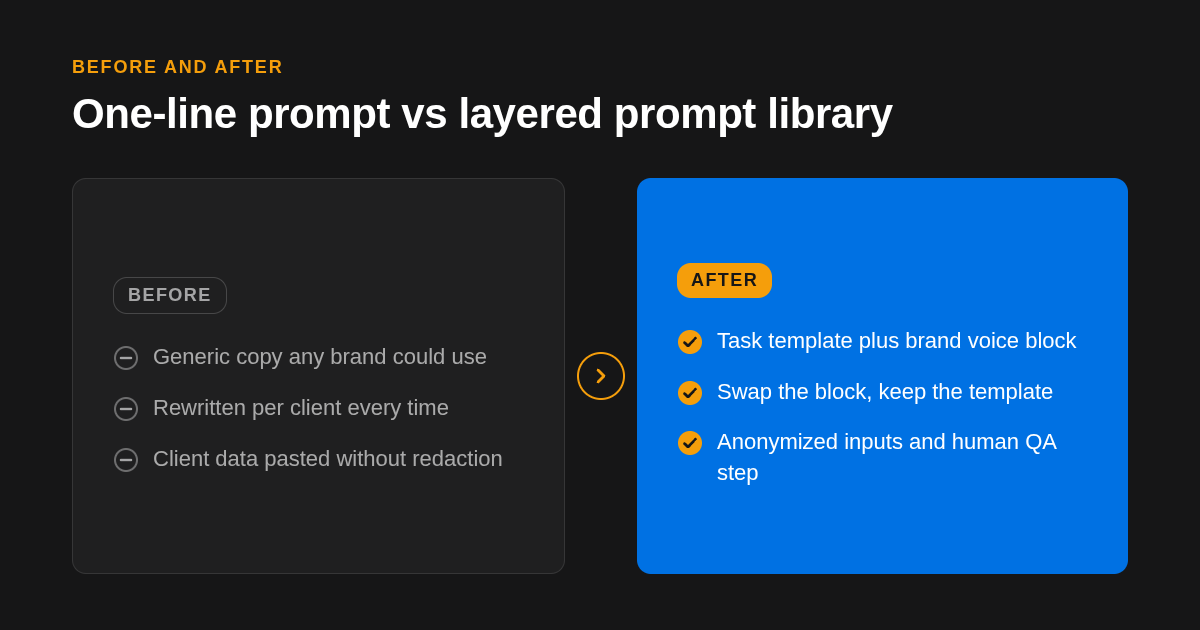
Separate the prompt into two layers: a fixed task template and a per-client brand voice block stored as a system prompt, a Custom GPT, a Claude Project, or a Gemini Gem. Keep the brand block to five fields: voice adjectives, banned words, sample sentences, audience, and offer. Swap the block, keep the template, and output stays consistent.
This is the part the ranking pages skip, and it is the difference between a prompt collection and a prompt library. In practice we store task templates in a shared Notion database or Google Sheet with columns for stage, task, template text, variables, and last reviewed date, and we keep one brand block document per client.
Brand voice block:
Brand voice for [client]: Tone adjectives: [three]. Never use: [list]. Reading level: [grade]. Sentence length: mostly under 20 words. Audience: [persona summary]. Offer: [one sentence]. Sample sentences in our voice: "[one]" "[two]" "[three]". When unsure, choose the plainer option.
On tool choice: ChatGPT Plus and Claude Pro are each published at $20 per month at the time of writing, and both support saved instructions and file uploads; confirm current pricing on the vendor sites. Gemini's paid tier is bundled into Google's consumer AI subscription, and Jasper is sold as a per-seat subscription aimed at marketing teams with built-in brand voice features. For the prompts in this article, the model matters less than whether your tier supports persistent instructions and turns off training on your inputs.
Searchers also look for free or PDF prompt packs. Every template here is free to copy into your own Sheet, and we keep the growing set of workflow templates on the Aipedians blog so you do not have to maintain a static PDF that goes stale.
Should agencies worry about client confidentiality when using AI prompts?
Yes. Treat every prompt as a potential data transfer. Use business or enterprise tiers where vendor terms state inputs are not used for training, strip client names and revenue figures before pasting, and never upload customer PII. Add a human QA step before any output reaches a client, which also catches invented statistics.
The NIST AI Risk Management Framework frames this as govern, map, measure, and manage. For an agency that translates to four habits: a written policy on what can be pasted, a list of approved tools and tiers, a redaction step, and a review step.
A practical redaction rule: replace client names with labels like Client A, replace exact revenue with ranges, and remove email addresses and phone numbers entirely. Most reporting and copy prompts work just as well on anonymized data.
Many agency contracts now include a clause on AI use. Check your master services agreements before running client data through any tool, and disclose AI assistance where the contract or the client asks for it.
How did we choose which prompts to include?
We compared the pages currently ranking for this keyword against the prompting documentation published by OpenAI, Anthropic, and Google, then mapped the gaps to the five-stage agency workflow and to the published character limits in Google Ads and Meta ad specs.
How do you get started with Aipedians?
Copy the master template and the brand voice block into a shared document, pick one client, and run the onboarding and reporting prompts first because they return hours fastest. When you are ready for the full set of agency workflow prompts and the editing checklists we use before client delivery, visit Aipedians and start with the latest guides.
What do people also ask?
Which AI tool should a marketing agency use for these prompts, and does it matter?
Any of ChatGPT, Claude, or Gemini will run these templates. ChatGPT Plus and Claude Pro are each published at $20 per month at the time of writing; confirm on the vendor sites. What matters more is whether your tier supports saved system instructions, file uploads for CSV reporting data, and a setting that stops your inputs from being used for training.
Are there free or PDF AI prompt libraries for marketing agencies?
Every template in this article is free to copy. We recommend keeping prompts in a shared Notion database or Google Sheet rather than a PDF, because templates change as tools update. Aipedians publishes additional agency workflow prompts on its blog at aipedians.com/blog so you can pull the current version instead of a stale download.
Can AI prompts help an agency win new clients and scale without adding headcount?
They can compress the time spent on proposals, briefs, onboarding research, and monthly reports, which are the most repetitive parts of agency work. The gains come from chained prompts plus a human review step, not from publishing raw output. Agencies that skip QA tend to lose the time saved to client revisions.
How do agencies use AI prompts for client reporting rather than just copywriting?
Export campaign data as CSV, anonymize it, and paste two periods into a prompt that asks for a comparison table, variance drivers, one risk, and three recommendations with confidence levels. The model drafts the narrative and a human verifies every figure against the ad platform before the report is sent.
What is the first AI prompt a marketing agency should start with?
Start with the brand voice block for one client, saved as a system prompt or project instruction. Every other prompt in the lifecycle depends on it. Then run the reporting prompt on last month's data, because it produces an immediate, measurable time saving and shows the team where the model needs correction.
Related Articles



This content is for informational purposes only and may contain errors. Please contact us to verify important details.