Aeo Tools for Small Business
Of the AEO tools for small business we reviewed, the right pick depends on one question: do you want a free snapshot, a low-cost tracker, or help acting on what the tracker shows? If you want a free check first, the HubSpot AEO Grader takes a few minutes, and the cheapest ongoing tracker we found starts at $29 per month. For help beyond a dashboard, see what we offer on aipedians.com. To be clear, Aipedians is not an Authorized Economic Operator customs consultancy; in this guide AEO means answer engine optimization.
Key takeaways
- Free first step: the HubSpot AEO Grader is free to run and scores how AI assistants currently describe your brand, so it is the right baseline before spending anything.
- Cheapest paid tracker: Otterly AI publishes a Lite plan at $29 per month, which makes it the lowest-cost self-serve option we found; confirm prompt limits on its pricing page.
- If you already pay for Semrush: the AI Visibility Toolkit add-on is listed at $99 per month, so test it before buying a standalone tool.
- Enterprise-only: Profound and Scrunch AI are quote-based and built for large brands and agencies, not sub-$100 monthly budgets.
- Where we fit: if nobody on your team has time to act on a dashboard, look at what we offer on aipedians.com before you pick a tool.
Is AEO just another name for SEO or GEO?
AEO, or answer engine optimization, is the practice of getting your business named or cited inside AI-generated answers from ChatGPT, Google AI Overviews, Perplexity and Gemini. Traditional SEO targets ranked blue links; GEO (generative engine optimization) overlaps heavily with AEO, and most tools use the labels interchangeably. AEO here does not mean customs certification. Small businesses tracking which AI assistants surface their brand can start with the $29 Lite plan from Otterly, which monitors prompt responses across ChatGPT, Perplexity, and similar engines without requiring an enterprise contract.
The split matters because answer engines reward different things. Google ranks pages, while ChatGPT and Perplexity assemble one answer and cite a handful of sources, so sitting on page one is not the same as being quoted. Gartner predicted that traditional search engine volume will drop 25% by 2026 as users shift to AI chatbots, which is why small teams are now asking about these tools at all.
One quick disambiguation. "AEO" is also the Authorized Economic Operator status issued by customs authorities, described on the European Commission's customs site. If you searched for customs certification, supply chain security audits, or import compliance software, this post is not about that.
GEO is the term Geoptie and a few other GEO tools prefer. In practice, AEO tools and GEO tools track the same thing: whether a generated answer mentions you. We keep a running set of answer-first content guides on our blog if you want the writing side of this.
How do AEO tools actually work?
An AEO tool sends a fixed list of prompts to AI engines on a schedule, usually daily, records whether your brand is mentioned or cited, and reports share of voice against competitors. Most also list which pages the engines cite, so you can see what content earns citations. Very few deliver true real-time data.
Three numbers appear in almost every dashboard. Mentions count how often your brand appears in the answer text. Citations count how often your URL is linked as a source. Share of voice compares both against named competitors across the same prompt set.
Engine coverage varies. Semrush, Ahrefs Brand Radar, Profound and Peec AI track ChatGPT, Gemini, Perplexity and Google AI Overviews, and several now add Google AI Mode and Claude. Check the vendor's coverage page before buying, because a tool that skips AI Overviews misses the engine most of your customers see first.
On real-time data: AI answers change with every session, so tools sample prompts, typically once a day, and some offer on-demand re-runs. Treat "real time" in marketing copy as "daily refresh" unless the vendor states otherwise. Google's documentation on AI features in Search also says there is no special markup that earns a citation, which is why these tools report on content quality rather than tags.
Which AEO tools fit a small business budget?
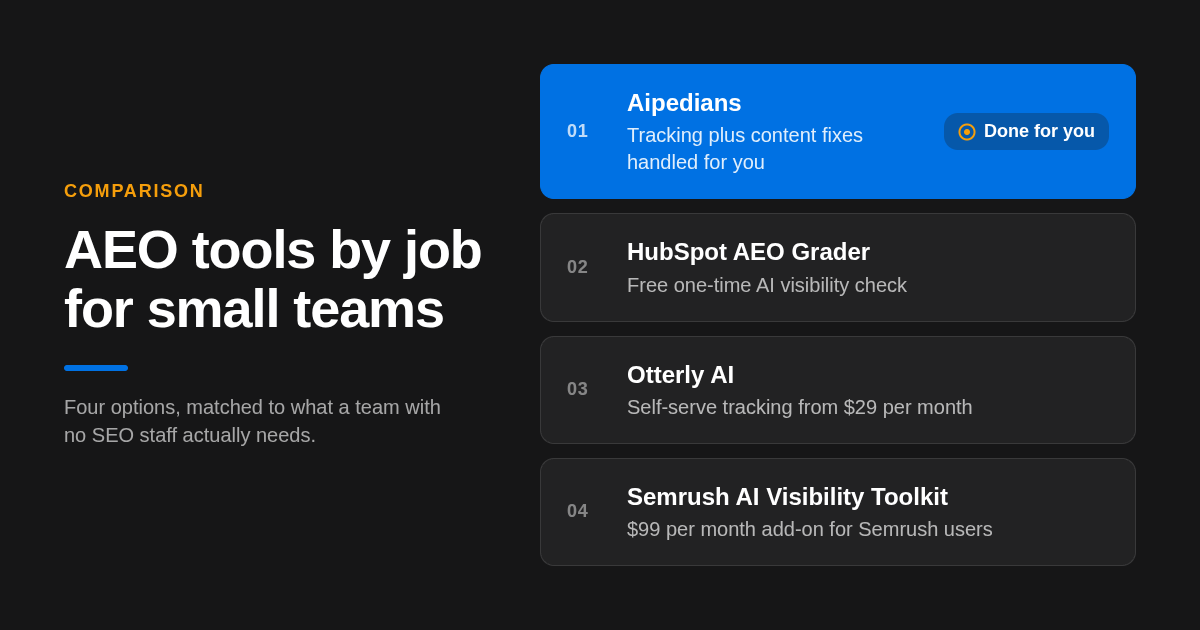
For a team with no dedicated SEO staff, the shortlist is short: HubSpot AEO Grader for a free one-time check, Otterly AI for a low-cost self-serve tracker, the Semrush or Ahrefs add-ons if you already pay for those suites, and Aipedians if you want help beyond a self-serve tracker (current details are on aipedians.com). Profound and Scrunch are enterprise-priced.
| Option | Best for | Pricing or format | Standout limit |
|---|---|---|---|
| Aipedians | Owners who want help acting on their AI visibility results | See aipedians.com for current plans and details | Not scored here on engine coverage or prompt limits like the trackers below |
| HubSpot AEO Grader | A free one-time visibility check | Free | No ongoing tracking or competitor history |
| Otterly AI | Lowest-cost self-serve prompt tracking | Lite plan at $29 per month; confirm limits on otterly.ai | Small prompt allowance on the entry plan |
| Semrush AI Visibility Toolkit | Existing Semrush customers | $99 per month add-on; confirm on semrush.com | Only useful alongside a Semrush subscription |
| Ahrefs Brand Radar | Existing Ahrefs customers | Included in Ahrefs plans, which start at $129 per month; confirm on ahrefs.com | Tied to an Ahrefs subscription |
| Peec AI | Marketing teams tracking several brands | Monthly plans published in euros; confirm current entry price | Costs climb as you add prompts and brands |
| SE Visible (SE Ranking) | Teams already on SE Ranking | Sold within SE Ranking plan tiers; check current pricing | Depends on the wider SE Ranking plan |
| Profound | Enterprise brands across many markets | Quote-based for most plans | Built for analyst teams and enterprise budgets |
| Scrunch AI | Mid-market and enterprise content teams | Quote-based | Overkill for a solo owner |
Aipedians sits first because the limit on small teams is rarely data, it is time to act on the data. We do not list our own plan details in this guide; you can see what we offer on aipedians.com and judge whether it fits alongside the trackers above.
The HubSpot AEO Grader is the best free AEO tool for a first look, but it is a snapshot. It will not show you week-over-week change or which competitor page replaced you.
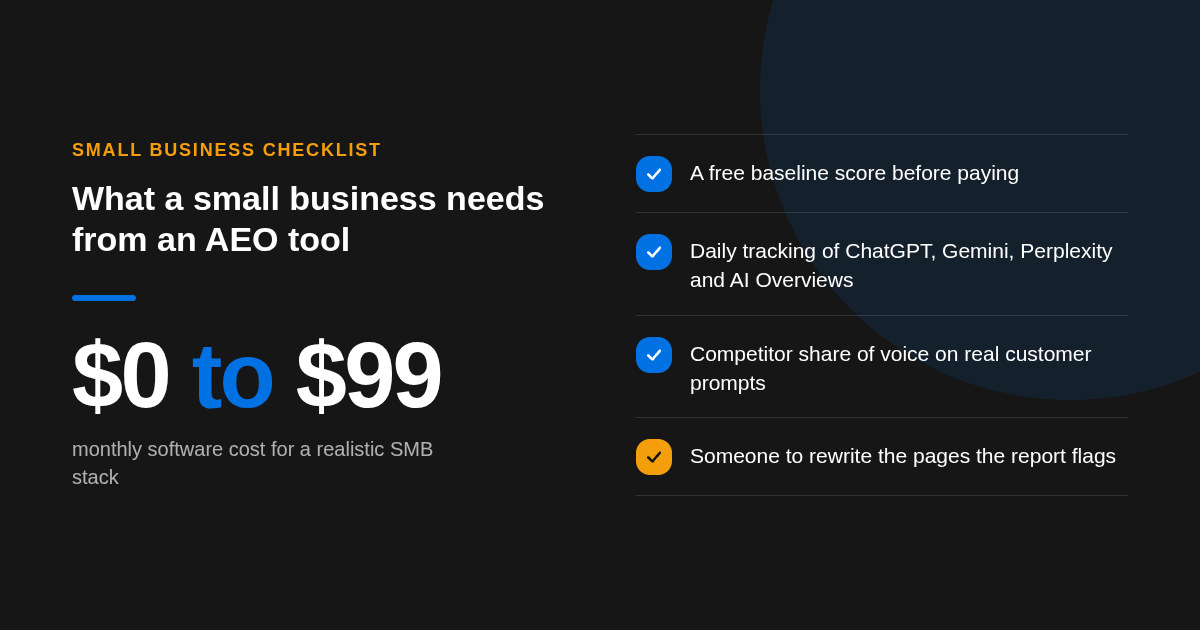
Add it up and a realistic small-business stack costs between $0 and $99 per month in software: the free grader for a baseline, then either Otterly's $29 Lite plan or the Semrush add-on if that suite is already paid for.
Should you buy a standalone AEO tool if you already use Semrush or Ahrefs?
Usually no, at least not at first. If you already pay for Semrush, the AI Visibility Toolkit add-on is published at $99 per month, and Ahrefs includes Brand Radar inside its paid plans, so test the built-in option before adding another subscription. Buy standalone only when you need deeper prompt volume or a done-for-you service.
Use three questions. Budget: if the ceiling is under $100 per month, you are choosing between HubSpot's free grader, Otterly's entry plan, and an add-on to a suite you already pay for. Stack: if Semrush or Ahrefs is already on the card, switch on the built-in AI visibility reports and run them for 30 days before paying anyone else.
Goals decide the rest. If the goal is a chart for a monthly report, a tracker is enough. If the goal is actual citations, a service that edits pages beats a tool that only reports, because the tool never changes your content.
Time is the hidden cost. A dashboard needs someone to pick prompts, read reports, and rewrite pages. If nobody on the team has two hours a week for that, the tool will sit unused, which is worth weighing before you buy anything.
What should a small business do first after seeing its AI visibility score?
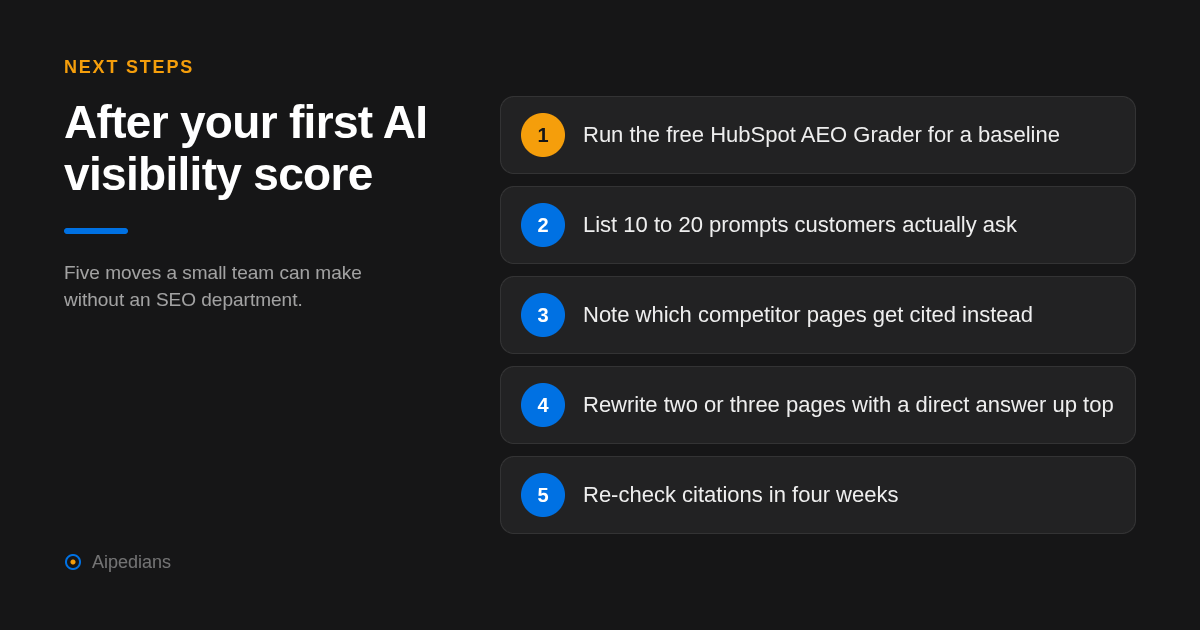
Treat the first score as a baseline, not a verdict. Write down the 10 to 20 prompts a customer would actually ask, note which competitors get cited instead of you, then fix the two or three pages those prompts relate to: add a direct answer at the top, clear headings, and a dated author. Re-check in four weeks.
A minimal weekly routine for a two-person team takes about an hour. Monday: scan the prompt report for lost or gained citations. Mid-week: update one page using the answer-first format we walk through in our small business AEO articles. Friday: note which competitor pages got cited and why, usually a clearer definition, a visible price, or a comparison table.
Expect slow movement. AI engines re-crawl and re-weight sources on their own schedule, so judge progress over four to eight weeks, not days. If a prompt has no small-business-friendly answer online, writing that answer is often the fastest win.
Which criteria shaped this small business shortlist?
We compared each tool's public pricing page, free-plan limits, and stated AI engine coverage at the time of writing, then filtered for what a team without an SEO hire could realistically run each week. We did not run a paid head-to-head benchmark. Prices change often, so confirm current figures on each vendor's site before you commit.
What is the next step once you pick an AEO tool?
Start with a free HubSpot grade so you have a baseline, list the prompts your customers really type, and decide who will act on the results each week. If that person does not exist on your team, look at what we offer on aipedians.com and check the current details there rather than relying on any figure in this guide.
Ready to be cited instead of skipped? Visit aipedians.com and tell us which AI answers you want your business to appear in.
Which AEO tool questions come up most from small teams?
Is AI SEO the same as AEO?
Mostly yes. AI SEO is a broad label for optimizing for AI-driven search, while AEO specifically targets being cited inside generated answers from ChatGPT, Gemini, Perplexity and Google AI Overviews. The tools and tactics overlap almost completely; the difference is wording, not method. Couples who want structured checklists and vendor communication logs will find that the Best Wedding Coordination Tools for Couples applies the same cost-tier logic used to evaluate small business AEO tools.
What are some effective tools for SEO marketing?
For a small business, a workable stack is Google Search Console (free) for rankings and clicks, the HubSpot AEO Grader (free) for an AI visibility baseline, and one paid tracker such as Otterly AI at $29 per month or the Semrush AI Visibility Toolkit at $99 per month if you already use Semrush. For help beyond tooling, see aipedians.com.
What AEO tools have the best real-time data capabilities?
No tool is truly real time because AI answers change with every session. Profound, Peec AI and Semrush refresh prompt results daily and some allow on-demand re-runs, which is as close as the category gets. For a small business, a daily refresh is enough; weekly review is what actually drives changes.
How does AEO work?
AEO works by making your pages the clearest, most quotable answer to specific questions: a direct answer in the first paragraph, question-style headings, concrete numbers, and credible sources. AEO tools then track whether ChatGPT, Gemini, Perplexity and AI Overviews mention or cite you for those questions and how you compare with competitors.
Which AEO tools are free for a small business?
The HubSpot AEO Grader is fully free and gives a one-time visibility score. Several trackers, including Otterly AI, offer trials or limited free runs, but ongoing prompt tracking with competitor history generally starts at $29 per month. Always check the free-plan prompt and brand limits on the vendor's pricing page before relying on it.
Related Articles



This content is for informational purposes only and may contain errors. Please contact us to verify important details.