Aeo Optimization for Agencies
AEO optimization for agencies works best as a repeatable four step module inside your existing SEO retainer: audit, answer first content, schema, and monitoring. At Aipedians we recommend this module approach over a separate AEO practice, because the same pages and hours serve both goals. AEO is not a replacement for SEO; it is a layer that makes content quotable by ChatGPT, Perplexity, Gemini, and Google AI Overviews.
Key takeaways
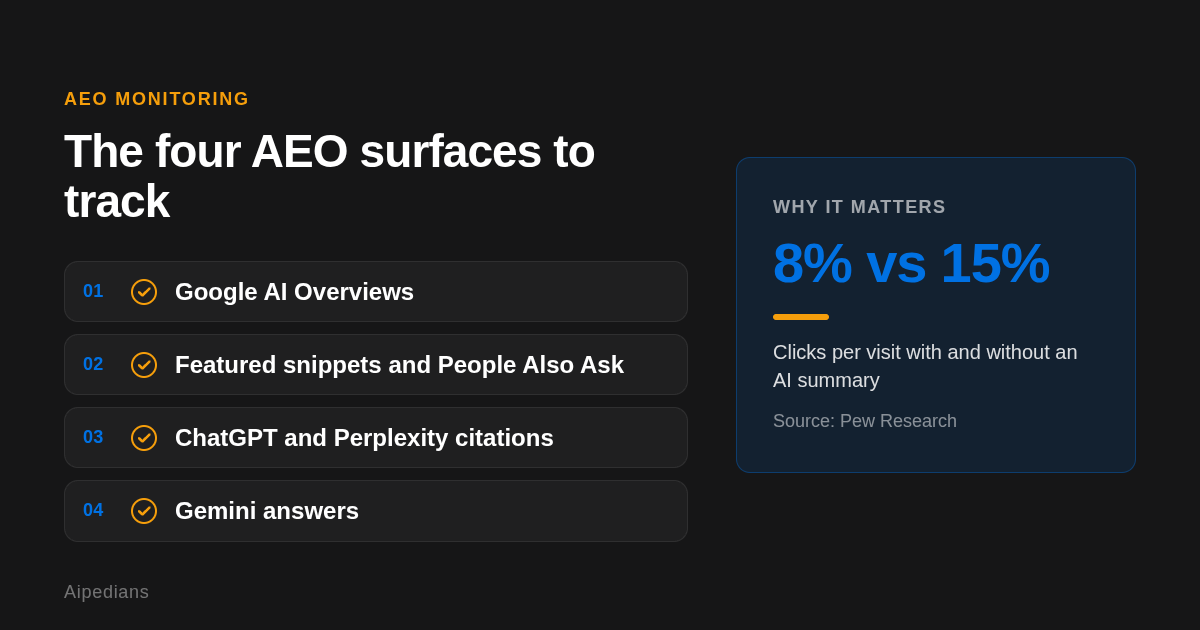
- Four surfaces matter: AEO targets Google AI Overviews, featured snippets, People Also Ask, and citations inside ChatGPT, Perplexity, and Gemini.
- Clicks are falling: Pew Research found users clicked a traditional result in 8% of visits that showed an AI summary, versus 15% of visits without one.
- Volume is shifting: Gartner predicted traditional search engine volume would drop 25% by 2026 as AI chatbots absorb queries.
- Schema priorities changed: Google restricted FAQ and HowTo rich results in 2023, so Organization, Article, and Product markup now do more work than FAQ markup.
- Report visibility, not sessions: the monthly AEO report tracks AI citation share, share of voice, snippet wins, and AI referral traffic.
Where does AEO sit between SEO and GEO for agency work?
Answer engine optimization (AEO) structures content so AI systems and search features can lift a direct answer from it. Traditional SEO earns rankings and clicks. Generative engine optimization (GEO) focuses on citations inside tools like ChatGPT and Perplexity. For agencies, AEO and GEO share one workflow; only the tracking surfaces differ.
The practical difference is the unit of success. SEO counts a position and a click. AEO counts whether your client's sentence appears inside the answer, with or without a click. Some vendors now use the label agentic engine optimization for the same idea applied to AI agents that complete tasks.
The shift is measurable. Pew Research tracked real browsing data and found clicks on traditional results fell from 15% to 8% of visits when an AI summary appeared. Gartner predicted a 25% drop in traditional search volume by 2026.
You do not need two strategies. You need one content system that produces direct answers, plus two sets of tracking: one for Google features and one for LLM citations.
How do agencies add AEO to existing SEO retainers?
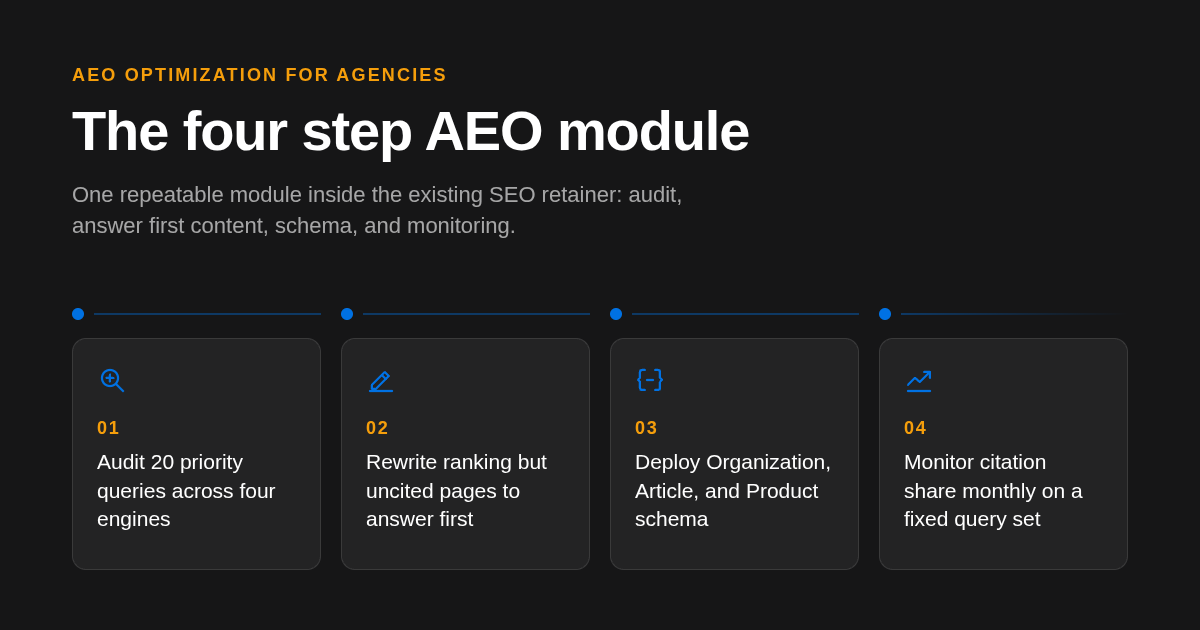
Add AEO as a defined module inside the retainer rather than a separate contract. The module runs four steps for every client: an AEO audit, answer first content rewrites, structured data deployment, and monthly AI visibility monitoring. Deliverables are a citation gap report, rewritten priority pages, a schema map, and a visibility dashboard.
Start with a reusable audit checklist. For each client, pick 20 priority queries and run them through ChatGPT, Perplexity, Gemini, and Google. Record who gets cited, whether the client's page answers the question in its first 60 words, and whether author and organization markup exist.
That audit becomes the gap report. Pages that rank but are not cited go to the rewrite queue first, because they already have authority and only need an answer first structure. New pages come second.
Scaling across many accounts needs one decision rule: automate the audit and schema generation, keep the answer writing and fact checking manual. Citation timing varies by client and engine, so set the expectation that results follow the next crawl and index cycle rather than promising a fixed number of weeks. Read more on the Aipedians blog.
Which content formats and schema types get cited by AI answer engines?
Pages that open each section with a direct, self contained answer of about 40 to 60 words get cited most often, followed by comparison tables, step lists, and original data. For schema, Organization, Article with author markup, and Product do the heaviest lifting, since Google restricted FAQ and HowTo rich results in 2023.
Answer engines reward entity clarity. Name the thing, define it, and state a number or decision rule in the same paragraph. Vague intros that promise an answer later get skipped.
Authority signals still decide close calls. Author bios with credentials, third party mentions of the brand, reviews, and original data all raise the odds of a citation. Google's own AI features guidance says no special markup is required for AI Overviews, which means the content itself carries the weight.
Use the Google structured data documentation as the source of truth for JSON-LD. FAQPage markup is still valid on schema.org, but Google now limits FAQ rich results to well known government and health sites, so do not sell it as a visibility lever.
Which tools should an agency use to track brand visibility in AI answers?
Use one free diagnostic and one paid tracker per account. HubSpot's AEO Grader gives a free citation snapshot for sales conversations. Semrush AI Toolkit, Ahrefs Brand Radar, and Profound track mentions and share of voice across ChatGPT, Perplexity, Gemini, and AI Overviews. Pick based on how many client domains you need to monitor.
| Tool | Best for | Pricing or format | Standout limit |
|---|---|---|---|
| HubSpot AEO Grader | Free pre-sales diagnostic | Free web report | One-off snapshot, no month over month trend |
| Semrush AI Toolkit | Agencies already on Semrush | Paid add-on priced per domain; confirm current pricing on semrush.com | Cost scales with every client domain added |
| Ahrefs Brand Radar | Agencies already on Ahrefs | Sold inside Ahrefs plans; confirm which tier includes it | Tied to your Ahrefs subscription level |
| Profound | Enterprise brands with large query sets | Custom enterprise pricing | Priced above what most small agencies can resell |
Whatever you choose, fix the query set at the start of the engagement. Changing the 20 tracked queries mid retainer breaks the trend line and makes the report unreadable to the client.
How do you measure and report AEO ROI when AI answers reduce clicks?
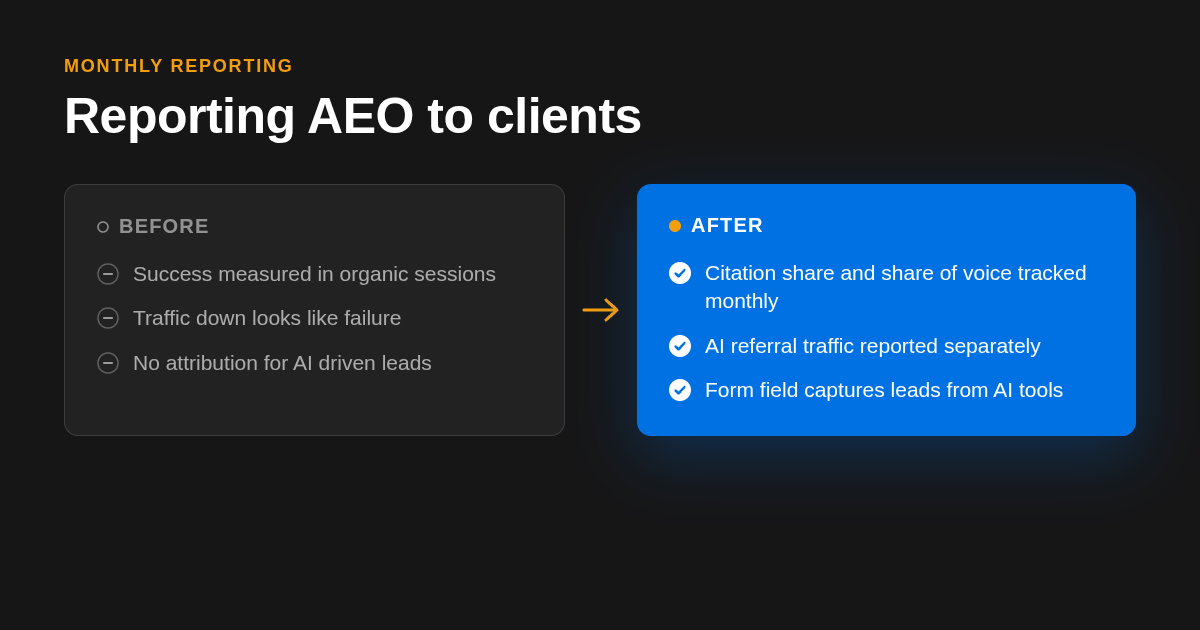
Report AEO on visibility and lead attribution, not sessions. Track four monthly KPIs: AI citation share across a fixed query set, share of voice against named competitors, snippet and People Also Ask wins, and referral traffic from chatgpt.com, perplexity.ai, and Gemini. Add branded search volume and a 'how did you hear about us' form field for attribution.
The hardest client conversation is "traffic is down but visibility is up." Handle it before it happens. Put the Pew click data in the kickoff deck, set the expectation that organic sessions may flatten, and agree in writing that citation share and attributed leads are the success metrics.
A simple dashboard works: one row per tracked query, columns for each engine, a cell showing cited or not cited, and a monthly total. Below it, list AI referral sessions and form leads that named an AI tool. Find more on the Aipedians blog.
Should agencies price AEO as an add-on or a standalone service?
Start as an add-on module to the SEO retainer, then spin it out as standalone once you have three client case studies. Add-on pricing is easiest to sell because the audit, content, and schema work reuse existing SEO hours. Standalone projects suit brands with in-house SEO who only need an audit and a reporting setup.
Package it in three tiers described by scope, not hours: an audit only project, an add-on module with monthly monitoring, and a full program with content rewrites included. Clients buy scope they can picture.
Proving expertise is the real sales problem, since directories of top AEO agencies rarely show evidence. Publish your own citation screenshots, track your agency's share of voice for your service keywords, and be honest that no Google issued AEO certification exists. Vendor certifications help, but live citations close deals. You can see how Aipedians frames AI search visibility for agency buyers on our site.
What criteria shaped this tool comparison?
We reviewed each vendor's public product page and published pricing model as of writing, checked which engines each tool reports on, and noted whether it offers month over month trend data. Where a vendor does not publish a fixed price, we describe the model and ask you to confirm on the vendor's site. We did not run paid benchmarks.
Where does Aipedians fit into your AEO module?
This guide outlines how the four step module fits inside an existing SEO retainer, what each deliverable looks like, and how to present citation share to clients each month. To learn more about how we approach AI search visibility for agencies, visit aipedians.com.
Which AEO questions do agency owners raise most?
How do SEO agencies add AEO to their service offerings and what do deliverables look like?
Add AEO as a module inside the SEO retainer with four deliverables: a citation gap report built from 20 tracked queries, rewritten priority pages with answer first sections, a schema map covering Organization, Article, and Product markup, and a monthly AI visibility dashboard.
What is the step by step process for implementing AEO for a client?
Audit first: run 20 priority queries through ChatGPT, Perplexity, Gemini, and Google and record who is cited. Then rewrite ranking but uncited pages with 40 to 60 word direct answers under question headings. Deploy JSON-LD schema next. Finally, monitor citation share monthly against a fixed query set.
Which tools track brand visibility in AI Overviews, ChatGPT, Perplexity, and Gemini?
HubSpot AEO Grader gives a free one-off snapshot. Semrush AI Toolkit and Ahrefs Brand Radar add AI tracking to platforms many agencies already pay for. Profound serves enterprise brands with custom pricing. Confirm current pricing on each vendor's site before reselling.
How do you report AEO ROI to clients when AI answers reduce clicks?
Shift the success metric from sessions to AI citation share, share of voice, snippet and People Also Ask wins, AI referral traffic, branded search lift, and leads that name an AI tool on your form. Pew Research found clicks fall from 15% to 8% of visits when an AI summary appears, so set that expectation at kickoff.
What is the difference between AEO, GEO, and traditional SEO, and does an agency need separate strategies?
SEO earns rankings and clicks, AEO earns direct answer placements in Google features, and GEO earns citations inside LLM tools. One answer first content system serves all three; only the tracking differs, so agencies do not need separate strategies.
Related Articles



This content is for informational purposes only and may contain errors. Please contact us to verify important details.